
Choosing the right Dubai free zone is one of the most critical decisions you will make when establishing a business in the United Arab Emirates. Among Dubai’s top jurisdictions, Meydan Free Zone and IFZA Free Zone (International Free Zone Authority) consistently lead the market for startups, consultants, e-commerce brands, and international entrepreneurs.
Both offer 100% foreign ownership, full profit repatriation, zero personal income tax and paperless procedures. But, freezone A and B differ for fees, visa quotas, having a physical office and branding of industry locations.
This ultimate guide gives a comparison between meydan and ifza, including details of the true setup costs, visa economics, banking support, and primary benefits to help you find the right business hub.
Which Dubai Free Zone Is Right for You?
If you are looking for a quick decision before diving into the detailed breakdown:
- Choose Meydan Free Zone if: You are a solo founder, consultant, or small team applying for 1 or 2 visas, need a central address in prime locations close to Downtown Dubai (Nad Al Sheba / MBR City) and are looking for a single visa entry with us inclusive.
- Choose IFZA Free Zone if: You want to grow your team to 3 to 6+ visas on a virtual desk without leasing a physical office, need industrial or specialized commercial activities, or want maximum flexibility of license upgrade.
What Is Meydan Free Zone?
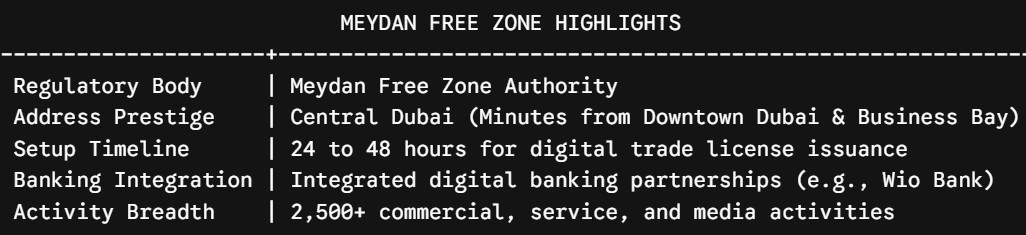
The Meydan Free Zone became part of the Meydan Group in 2009 and is located in a prime location at the Meydan Hotel, Nad Al Sheba, overlooking the MBR City. A centre for a number of digital entrepreneurs, media entities, management consultants, and light trading companies seeking a Dubai city presence.
What Makes Meydan Stand Out
- Central Address: Located minutes from Downtown Dubai and Business Bay, providing strong corporate brand positioning on business cards and bank applications.
- Bundled Entry-Level Value: Meydan’s entry package starting around AED 12,500 typically includes the trade license, virtual office address, and 1 visa allocation.
- Meydan Commerce & Pay Digital Tools: Features digital merchant payment gateways and built-in e-commerce infrastructure for online businesses.
What Is IFZA Free Zone?
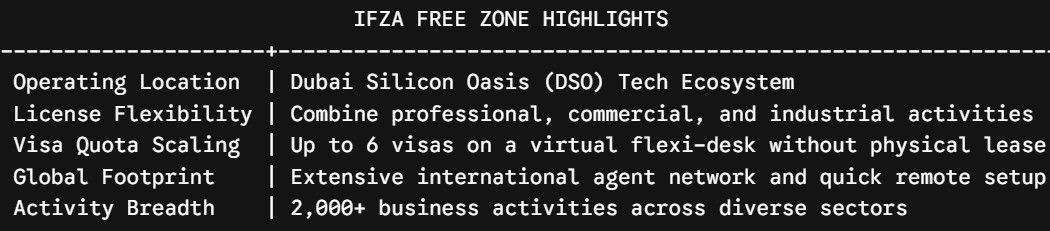
DSO approved International Free Zone Authority, is one of the fastest-growing business hubs in the UAE. IFZA aims to offer a cost-efficient, flexible, and reliable setup for International investors, consultants, tech companies, and commercial trading companies.
What Makes IFZA Stand Out
- Package-Based Visa Quota: IFZA allows companies to hold up to 6 visas on a virtual flexi-desk package without forcing the owner to rent physical office floor space.
- Combined License Categories: Allows business owners to combine commercial, professional, and industrial activities under a single trade license.
- International Support Infrastructure: Offers widespread global reach and efficient remote onboarding processes for foreign shareholders.
Meydan Free Zone vs IFZA
To evaluate ifza vs meydan free zone accurately, you must compare all-in setup costs, visa economics, banking compatibility, and office requirements.
1. True First-Year Setup Costs
A common point of confusion when comparing meydan vs ifza comes from headline landing page numbers:
- Meydan’s Baseline Price (~AED 12,500): Includes a trade license, virtual address, and 1 visa allocation.
- IFZA’s Baseline Price (~AED 12,900): Includes a trade license and virtual address with 0 visas included.
For a single-founder business needing 1 visa, Meydan often works out slightly more cost-effective in Year 1 because the visa allocation is bundled into the base tier.
2. Per-Visa Economics and Scaling
As your headcount grows, the pricing dynamic shifts:
- Small Teams (1–2 Visas): Both free zones cost roughly the same overall. Meydan’s per-visa slot cost stays low (~AED 3,500 per slot).
- Growing Teams (3–6 Visas): IFZA becomes highly efficient because its tier packages grant higher visa headroom on a virtual desk without forcing you to rent physical office space.
3. Banking Approval Rates and Compliance
They are each recognized by leading local digital banks (e.g. Wio Bank) and established banks (e. g. Emirates NBD, Mashreq). Meydan’s prime location at the heart of Downtown Dubai might give a slight advantage in our clients’ branding perceptions; whereas IFZA’s standardized paperwork simplifies the due diligence process.
Guide to Setting Up Your Company
Whether you choose Meydan or IFZA, the company registration sequence follows a structured path managed by your corporate services partner.
Step 1: Business Activity Mapping
Select your business activities from the official directory. Confirm whether your activity requires special third-party regulatory approvals.
Step 2: Package Selection and Name Reservation
Select your license duration and required visa quota. Submit three proposed trade names following UAE naming rules.
Step 3: KYC Submission and Legal Document Signing
Upload passport copies, proof of address, and passport photos for all shareholders. Sign the Memorandum of Association (MOA) electronically.
Step 4: Trade License and Establishment Card Issuance
Pay the government fees to receive your digital Trade License. Register your business file with immigration to issue your company Establishment Card.
Step 5: Medical Fitness Test and Emirates ID Capture
Fly to Dubai to complete the mandatory medical fitness exam (blood test and chest X-ray) and attend your Emirates ID biometric appointment.
Step 6: Bank Account Onboarding and Corporate Tax Registration
Submit your trade license, Emirates ID, and business profile to open your corporate bank account. Register your company for Corporate Tax with the Federal Tax Authority (FTA).
Understanding Corporate Tax for Free Zone Companies
Holding a license in Meydan or IFZA subjects your entity to UAE Corporate Tax rules under Federal Decree-Law No. 47 of 2022.
Qualifying Free Zone Person (QFZP) Rules (0% vs. 9%)
To maintain 0% Corporate Tax status on qualifying profits, your business must satisfy all Qualifying Free Zone Person (QFZP) requirements:
- Maintain adequate economic substance (workspace and local operational presence).
- Derive income from qualifying activities or transactions with other free zone entities.
- Prepare annual audited financial statements under IFRS standards.
- Comply with transfer pricing rules and keep non-qualifying revenue below the de minimis limit (the lower of 5% of total revenue or AED 5,000,000).
If your business fails to meet QFZP requirements, taxable net profit above AED 375,000 is taxed at the standard 9% corporate tax rate.
Benefits of Free Zone Company Formation in Dubai
Setting up a business in Meydan or IFZA provides key strategic advantages:
- 100% Foreign Ownership: Retain complete equity control over your enterprise without needing a local Emirati partner.
- 100% Capital Repatriation: Move profits and capital globally without foreign exchange restrictions.
- 0% Personal Income Tax: Pay zero personal tax on salaries, dividends, and personal capital gains.
- Streamlined Residency Visas: Secure 2-year renewable investor and employment residency visas for founders, family members, and staff.
Frequently Asked Questions (FAQs)
How many business activities can I include on a Meydan or IFZA license?
Meydan allows you to combine up to 3 business activities under one license. IFZA allows you to combine up to 3 to 7 activities depending on the license tier, across professional, commercial, and service categories.
Do I need a physical office space to get visas in Meydan or IFZA?
No. Both free zones provide virtual office / flexi-desk options that allow you to secure investor and employment visas without leasing a physical office unit.
Can I open a UAE bank account with a Meydan or IFZA trade license?
Yes. Both jurisdictions are fully recognized by local digital banks (like Wio) and traditional corporate banks in the UAE, provided you present a complete compliance file and Emirates ID.
Are audited financial statements required for Meydan and IFZA companies?
Under UAE Corporate Tax laws, any Free Zone business seeking to benefit from the 0% Qualifying Free Zone Person (QFZP) tax rate must maintain annual audited financial statements prepared under IFRS.