
Creating a Dubai mainland company is one of the popular methods of emerging in the UAE. Being the financial hub of the region, the city offers several benefits such as direct access to the local UAE markets, multi-million dollar government contracts, and access to trade markets around the world.
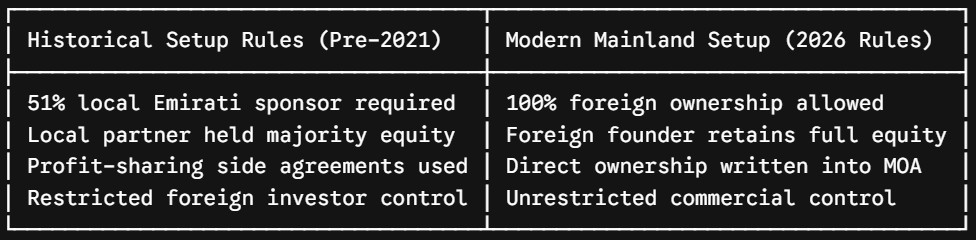
Unlike entities restricted to specific free zone boundaries, a mainland business provides complete operational freedom. Following major updates to the UAE Commercial Companies Law, foreign investors can now establish a business on the mainland with 100% foreign ownership, eliminating the historical requirement for a local sponsor.
This comprehensive guide covers everything you need to know about mainland company formation in Dubai: legal structures, 100% ownership rules, step-by-step DET registration, physical workspace (Ejari) mandates, and real cost expectations.
What Are Mainland Company Structures in Dubai?
A mainland company – often referred to as an onshore entity – is a commercial enterprise registered directly with the Dubai Department of Economy and Tourism (DET).
Defining the UAE Onshore Framework (DET Licensing)
Mainland entities operate under federal UAE commercial law. Having a license issued by the DET allows your company to trade legally across all seven Emirates without geographical restrictions or special permits.
100% Foreign Ownership Reforms Explained
UAE authorities abolished a centuries-old rule that forced foreign business owners to have a local partner with a 51 percent stake in more than 1,000 commercial and industrial activities. This was enacted by Federal Decree-Law No. 26 of 2020. Now, foreign business owners can own 100 percent of their mainland business.
Mainland Onshore vs. Free Zone Jurisdiction Differences
When it comes to real exporting, the Free Zone is perfect if you’re working in international consulting, developing technology, or setting up for zero-visa remote work. But there are limitations on doing business inside the local UAE mainland. The totally unrestricted mainland company can set up physical retail outlets, branches across the entire country, and bid for local government tenders.
Why Choosing the Right Company Structure Matters
Selecting the appropriate corporate structure during incorporation impacts your legal liability, tax obligations, and commercial expansion capabilities.
Operational Reach and Direct Local UAE Market Access
A Mainland Licence enables you to carry out B2B and B2C sales to UAE consumers, open retail outlets, restaurants, warehouses anywhere across Dubai, and expand your presence to every commercial area of Dubai.
Government Tenders and Commercial Contract Bidding
If your business model involves bidding on government contracts, municipal projects, or semi-governmental infrastructure tenders, a mainland DET trade license is mandatory. Free Zone entities are generally excluded from participating in government procurement.
Visa Quota Scaling and Physical Office Expansion
Mainland entities are not bound by fixed package visa limits. Your visa quota scales directly with your physical office size – allowing you to hire more employees as you expand your workspace footprint.
What Are the Different Mainland Company Structures in Dubai?
When registering a mainland business with the DET, you can choose from four primary legal structures:
Limited Liability Company (LLC)
The Limited Liability Company (LLC) is the most popular structure for foreign investors. It requires 1 to 50 shareholders and can conduct commercial, industrial, or trading activities. Shareholders are liable only to the extent of their share capital, protecting personal assets.
Sole Establishment
Sole Establishment – owned by one person. Ideal for professional services and consultancy businesses or small artisan businesses. The sole proprietor has 100% control of the business but has unlimited liability for any commercial debt incurred.
Civil Company
This format enables two or more professionals (doctors, lawyers, engineers, and consultancies) to join forces to provide a professional service. It permits 100% foreign ownership, but the partners are jointly responsible for the commitments of the business.
Branch of a Foreign or Local Company
Any existing international or local company can form a Registered Branch in Dubai. This is an extension of the company and there will be no new legal entity formed. The branch will operate with the same brand name and activities.
How Do Mainland Company Structures Differ?
Understanding how these legal structures compare helps ensure you pick the right legal framework for your venture:
- Share Capital Protection: An LLC separates your corporate liabilities from your personal assets, making it safer for commercial trading and retail.
- Local Service Agent (LSA) Mandate: Some business activities may be established as Sole Establishments / Civil Companies and will require an Agent for Local Service (LSA). The LSA shall not contribute any capital and shall be paid an annual fixed service fee.
- Capital Requirements: DET mainland companies have no mandatory minimum paid-up capital requirement for most commercial activities, giving startups cash flexibility during incorporation.
Which Mainland Company Structure Is Right for You?
Match your business model to the appropriate legal structure using these guidelines:
- For Commercial & General Trading: Choose a Mainland LLC. This structure allows you to import, export, and distribute goods locally while limiting shareholder financial liability.
- For Professional Consultants & Freelancers: Choose a Sole Establishment or Civil Company. These structures offer lower initial setup costs and direct 100% foreign ownership.
- For Established Global Brands: Choose a Branch Office. This allows you to leverage your existing global track record to secure major UAE corporate clients and government tenders.
Step-by-Step Process: How to Setup a Mainland Company in Dubai
Setting up a mainland company follows a clear sequence managed through the DET:
Step 1: Select Approved DET Business Activities
Choose your business activities from the official DET directory to ensure your trade license matches your operational revenue model.
Step 2: Choose Legal Structure and Reserve Trade Name
Select your corporate structure (LLC, Sole Establishment, or Branch) and submit three compliant company names to the DET for official clearance.
Step 3: Obtain DET Initial Approval
Submit passport copies and identity documents to secure DET initial approval, confirming that the government raises no objections to your entity incorporation.
Step 4: Draft and Notarize the Memorandum of Association (MOA)
Draft the official Memorandum of Association (MOA) defining share capital, ownership percentages, and management rights. Notarize the document through a Dubai public notary.
Step 5: Secure Commercial Workspace and Register Ejari
Lease a physical commercial office, serviced office, or flexi-desk package. Register the lease with the Dubai Land Department to receive your official Ejari certificate.
Step 6: Secure External Government Approvals (If Required)
Obtain specialized permits from relevant government departments if your activity falls under regulated sectors (e.g., DHA for medical, KHDA for education, or RERA for real estate).
Step 7: Pay Government Vouchers and Receive DET Trade License
Submit your final dossier to the DET and settle the official licensing voucher. Your official mainland trade license is issued electronically.
Step 8: Complete Immigration Setup, Visas, and Corporate Banking
Register your business with MOHRE, receive your company Establishment Card, complete shareholder medical exams and Emirates ID biometrics, and open a corporate bank account.
Dubai Mainland Company Formation Cost Breakdown
Budgeting accurately for dubai mainland company formation cost requires looking at all mandatory line items:
- Baseline DET Trade License: AED 13,000 to AED 15,000. Covers name reservation, initial approval, MOA vouchers, and core licensing fees.
- Entry-Level Setup Package (Flexi-Desk Address): AED 25,000 to AED 28,500 total. Ideal for professional consultants or digital services needing a mainland license at a lower entry cost.
- Full Physical Operational Setup (Office & Visas): AED 35,000 to AED 55,000+ total. Covers license fees, physical commercial rent (AED 15,000–40,000+), Ejari fees (5% of rent), Establishment Card, and 1 to 2 residency visas.
- Residency Visa Expenses: AED 3,500 to AED 7,000 per visa (covers entry permits, medical tests, Emirates ID, and stamping).
- Annual Renewal Budget: AED 13,000 to AED 15,000 for DET license renewal, plus ongoing commercial lease renewal and Ejari fees.
Want an exact, itemized price quote tailored to your planned business activities? The advisory team at Emifast provides transparent breakdowns with zero hidden agency fees.
Benefits of Establishing a Mainland Company in Dubai
A mainland company offers strategic advantages for long-term growth:
- Direct Local Market Trading: Sell products and services directly to UAE consumers and businesses across all seven Emirates.
- Unlimited Business Expansion: Open multiple physical branches, retail stores, or warehouses across Dubai without setting up duplicate legal entities.
- Bidding on Government Projects: Access profitable government tenders, municipal contracts, and regional infrastructure projects.
- Easier Corporate Bank Onboarding: Local UAE banks often view mainland entities favorably during Know Your Customer (KYC) compliance reviews compared to offshore or virtual setups.
Legal and Regulatory Requirements for Dubai Mainland Companies
Keep your new mainland business compliant with UAE federal regulations:
- UAE Corporate Tax (9% Rate): Mainland entities pay a flat 9% Corporate Tax on net taxable profits exceeding AED 375,000 (~$102,000 USD). Profits below this threshold are taxed at 0%. All active entities must register with the Federal Tax Authority (FTA).
- Value Added Tax (VAT): Register for 5% VAT with the FTA if your annual taxable turnover exceeds the mandatory threshold of AED 375,000 (voluntary registration is available at AED 187,500).
- Ultimate Beneficial Owner (UBO) Declarations: Maintain updated internal registers listing all natural persons who own or control 25% or more of the company’s shares or voting rights.
Frequently Asked Questions (FAQs)
Do I need a local UAE national sponsor to open a mainland company in Dubai?
No. Following the updates to the UAE Commercial Companies Law through Federal Decree-Law No. 26 of 2020, foreign investors can form a 100% foreign owned company in Dubai mainland, offering over 1,000 commercial and industrial activities. The only requirement is appointing a Local Service Agent (LSA) if you decide to operate in certain professional activities. However, they have no equity stake in your business.
What is the minimum cost to set up a mainland company in Dubai?
Starting from the most simple setup you should expect to pay somewhere AED 25,000 to AED 28,500 for a simple company on the Dubai mainland, which will include getting your DET business license, your business name reservation, and the paperwork to include your business. If you need it fully set up with an actual office (Ejari) and visa approval then you should expect to pay somewhere AED 35,000 AED to AED 55,000.
What is the difference between a mainland LLC and a Free Zone company?
Mainland companies have a license from the DET giving them permission to trade freely within the local UAE market, rent commercial property and bid for government contracts. Free Zone companies can only operate within their allocated geographical zone or trade internationally. If they want to trade freely within the local UAE mainland they require a local distributor or a special permit.
Is a physical office space mandatory for a Dubai mainland company?
Yes. The DET will require any businesses on the mainland to have a registered office address. This can be achieved with a flexible desk option or package from a business centre at a much more affordable price for new startups or consultancies.
How long does mainland company formation in Dubai take?
With clean documentation, it takes around between 3-7 working days to issue a DET trade license and initial approvals. The whole process can take between 2-3 weeks with Ejari registration, Establishment Card, residency visas and corporate bank account set up.