
Establishing a Dubai free zone company is one of the most effective ways for foreign investors, digital founders, and international trade enterprises to build a presence in the Middle East. Offering 100% foreign ownership, full capital repatriation, zero personal income tax, and dedicated industry hubs, Dubai’s free zones serve as a launching pad for global business expansion.
But choosing the best jurisdiction isn’t only based on headline setup costs. You have to take into account business activity restrictions, workspace needs, visa quota limits, banking openness and QFZP company tax regulation.
Whether you need an inexpensive setup for a solo or a corporate headquarters for an enterprise, our advisors at emifast provide guidance in an end-to-end manner in activation plans to obtain a trade license and setting up a corporate bank account.
What Is a Dubai Free Zone Company?
A Dubai free zone company is a corporate entity registered within a designated economic geographic zone governed by its own independent regulatory authority. Unlike standard international setups, free zones provide specialized business environments tailored to specific industries – such as technology, logistics, media, commodities, and financial services.
Dubai Free Zone Company At a Glance
Foreign Ownership: 100% Foreign Capital & Equity Ownership
Import/Export Duty: 0% Customs Duty on Goods Traded Inside Zone / Internationally
Personal Income Tax: 0% Personal Tax on Salaries, Dividends, and Capital Gains
Corporate Tax: 0% on Qualifying Income (Subject to QFZP Rules) / 9% Standard
Currency Rules: Zero Foreign Exchange Restrictions or Capital Caps
Visas Allocation: Tied directly to workspace size (Flexi-Desk to Office)
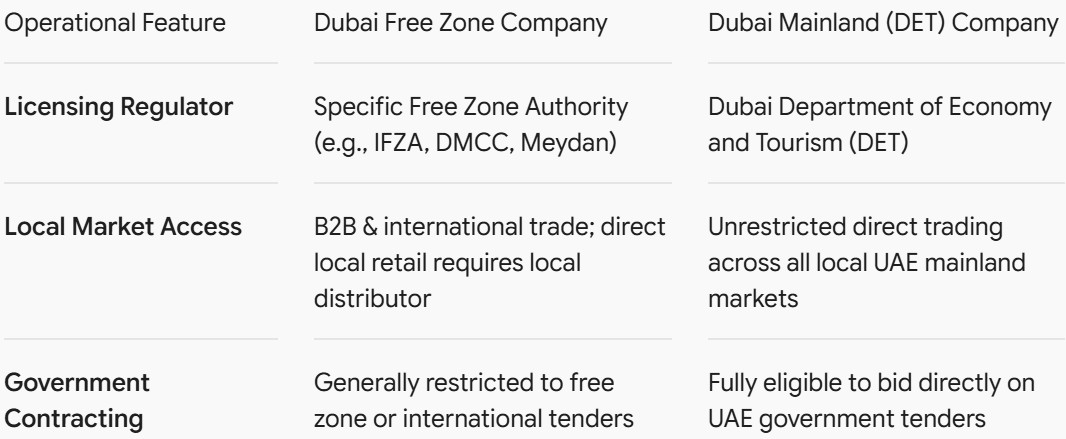
Free Zone vs. Mainland: Core Operational Differences
Understanding how a free zone company setup in dubai compares to a Mainland entity ensures you choose the proper corporate structure for your revenue model:
Top Dubai Free Zones for Business Setup
Dubai hosts over 30 free zones, each designed for specific commercial activities and operational scales:
1. International Free Zone Authority (IFZA)
- Primary Focus: Professional services, consultancy, technology, and general trading.
- Key Advantages: Highly cost-effective zero-visa packages, flexible license combinations under one permit, and fast online processing.
2. Meydan Free Zone
- Primary Focus: Digital business, e-commerce, media, and management consulting.
- Key Advantages: Centrally located near Downtown Dubai, allows up to three distinct business activity categories on a single trade license.
3. Dubai Multi Commodities Centre (DMCC)
- Primary Focus: Commodities trading, Web3/crypto, financial services, and global corporate headquarters.
- Key Advantages: Voted top global free zone multiple times, premium office towers in Jumeirah Lakes Towers (JLT), and access to the DMCC Crypto Centre.
Free Zone Company Formation Steps
Executing a Dubai free zone company formation follows a structured regulatory process managed by your chosen authority.
Step 1: Activity Selection and Jurisdiction Matching
Identify your commercial operations from the official free zone activity directory. Ensure your chosen activities match your planned revenue model and banking profile.
Step 2: Trade Name Reservation and Initial Clearance
Submit three proposed corporate names following UAE naming guidelines. Provide passport copies, proof of address, and passport photos for shareholder background checks.
Step 3: Legal Document Preparation and MOA Execution
Draft the company Memorandum of Association (MOA) and Articles of Association (AOA). Execute documents electronically or via the free zone portal.
Step 4: Workspace Lease Execution and License Issuance
Select a Flexi-Desk arrangement, co-working space, or dedicated commercial office. Pay the government licensing voucher to receive your digital Trade License and Certificate of Formation.
Step 5: Establishment Card Registration and Entry Permit
Apply for your company Establishment Card through immigration channels. Generate electronic entry permits for investors, partners, and employees.
Step 6: Medical Fitness Screening and Emirates ID Biometrics
Complete the mandatory medical fitness examination (blood screening and chest X-ray) at a preventive health center in Dubai and attend your Emirates ID biometric appointment.
Step 7: Corporate Bank Account Onboarding and Tax Registration
Authenticating your Business Please enable digital local banks like, Wio (for instance), or bank partners to verify your business file, business profile, and proof of business operation and open your corporation bank account. Claim your company for Corporate Tax from the Federal Tax Authority.
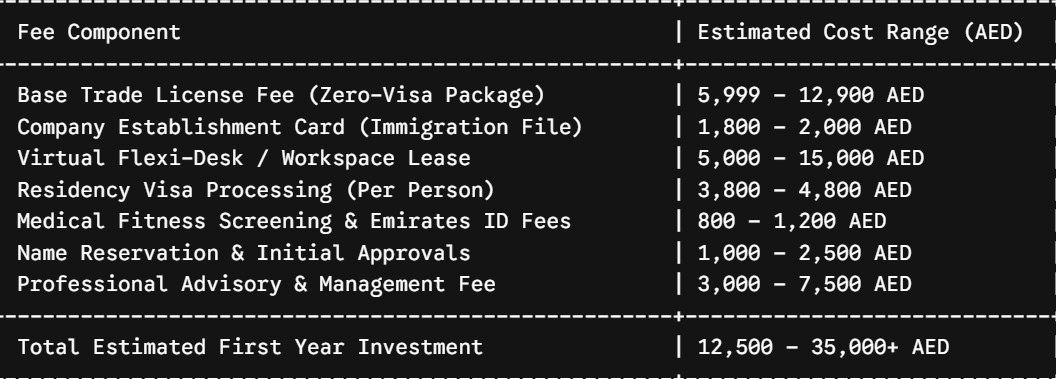
Dubai Free Zone Company Formation Cost Breakdown
You have to work the real Dubai free zone company formation cost by budgeting for the core license fees, the workspace allocations, or immigration registration, and the residency visa processing.
Scenario Cost Profiles
- Solo Founder (Zero Visas): Expect an all-inclusive investment ranging from AED 12,000 to AED 15,000 for a basic service license and virtual desk.
- Founder + 1 Investor Visa: Total costs average between AED 16,000 and AED 22,000, covering immigration files, medical screening, and Emirates ID processing.
- Premium Enterprise Hub (e.g., DMCC with Office & Visas): Entry-level setup packages start from AED 35,000 to AED 50,000+, reflecting premium location branding and infrastructure.
Understanding Corporate Tax Rules for Free Zone Companies
Following the introduction of federal Corporate Tax under Federal Decree-Law No. 47 of 2022, holding a free zone license alone does not automatically make your income tax-free.
The 0% Qualifying Free Zone Person (QFZP) Framework
To qualify for the 0% Corporate Tax rate on eligible profits, your business must meet all of the following statutory conditions as a Qualifying Free Zone Person (QFZP):
- Maintain Adequate Economic Substance: You must have a physical workspace, qualified local staff, and operational expenses within the free zone.
- Earn Qualifying Income: The Income generated from the dealings with other free zone entities, approved qualifying activities (i.e. manufacturing logistics, treasury, functions, or the headquarter services).
- Maintain Audited Financial Statements: You must prepare and maintain annual financial audits prepared under IFRS standards.
- Comply with Transfer Pricing Rules: All transactions with related parties must meet the arm’s length principle.
- Respect the De Minimis Limit: Non-qualifying revenue must not exceed the lower of 5% of total revenue or AED 5,000,000 in a tax period.
Benefits of Establishing a Dubai Free Zone Entity
Opening a free zone business in Dubai delivers major operational and financial benefits:
- 100% Capital & Equity Ownership: Complete control over your business without needing a local partner or sponsor.
- Complete Capital Repatriation: Move profits and capital globally without foreign exchange controls or withholding taxes.
- Simplified Global Banking: Establish business accounts with modern digital platforms like Wio Bank or established institutions like Emirates NBD and Mashreq.
- Streamlined Residency Sponsorship: Sponsor 2-year or 10-year investor visas for yourself, family members, and employees.
- Industry Ecosystem Access: Build credibility by operating inside world-class hubs alongside leading global corporations.
Frequently Asked Questions (FAQs)
Can a Dubai free zone company trade directly with UAE mainland customers?
A free zone entity can trade directly with mainland B2B entities for services. For physical products, direct sales in the local retail market will require a licensed distributor within the mainland or an official dual license.
Do I need to live in Dubai to own a free zone company?
No. You can incorporate a free zone company remotely from your home country. However, if you apply for a UAE Residence Visa and Emirates ID through your business, you must make a short trip to Dubai to complete medical checks and biometrics.
What is the cheapest free zone setup in Dubai?
Basic zero-visa packages in free zones such as Meydan or IFZA begin from AED 5,999 to AED 12,500 (approximately). Final prices are determined by the number of visas you need, as well as the office arrangements.
Are audited financial statements mandatory for free zone entities?
Yes. The UAE Corporate Tax law requires all the Free Zone Companies (FZCO) that are sponsored under QFZP of 0% to produce annual audited financial statements under IFRS to retain the 0% QFZP status.
How long does it take to get a Dubai free zone trade license?
Initial license registration and digital trade license issuance typically take between 3 and 7 business days once your corporate documents are submitted.