
Relocating to Dubai offers an attractive lifestyle, career growth, zero personal income tax, and world-class infrastructure. However, planning a successful transition requires a realistic understanding of the local cost structure. While the absence of personal income tax significantly boosts your net earnings, managing monthly expenses – from housing and district cooling to schooling and healthcare – is essential for long-term financial success.
Whether you are moving as a solo professional, establishing a corporate presence, or relocating with a family of four, this guide provides an itemized analysis of the cost of living in Dubai.
Is Dubai Expensive? An Overview of Expenses
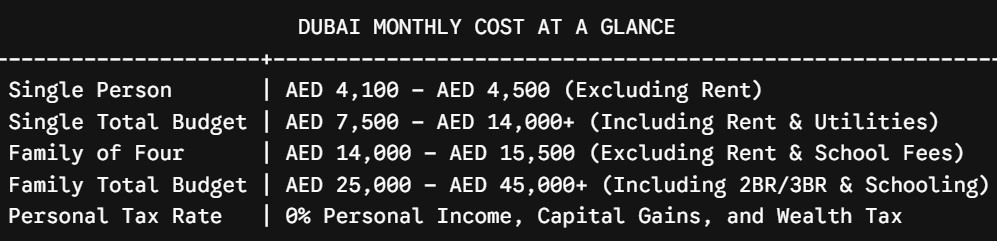
Is Dubai costly? It very much depends upon the way you set about living, where you set about living and what way you go about spending.
Key Factors Shaping Your Monthly Expenses
- Housing Location: Rent in central waterfront or business hubs (Downtown Dubai, Dubai Marina, Palm Jumeirah) can be double or triple that of suburban, family-friendly communities (Jumeirah Village Circle, Dubai Silicon Oasis, Dubai Sports City).
- Utility Type: Buildings equipped with central district cooling (such as Empower) carry separate monthly capacity charges compared to standard DEWA (Dubai Electricity and Water Authority) air conditioning.
- Private Education: Schooling for children is a major expense for expat families, with annual tuition fees varying widely based on curriculum and facilities.
Housing & Rent Costs in Dubai
Average Rent in Dubai by Apartment Type and Location
Apartment rents vary significantly based on neighborhood, building age, proximity to the Dubai Metro, and included amenities.
-
Studio Apartments:
-
-
- Value Suburbs (DSO, International City): AED 28,000 – AED 45,000 per year (AED 2,300 – AED 3,750 per month).
- Mid-Tier Communities (JVC, Sports City): AED 42,000 – AED 65,000 per year (AED 3,500 – AED 5,400 per month).
- Prime City Center (Downtown, Marina, Business Bay): AED 65,000 – AED 100,000+ per year (AED 5,400 – AED 8,300+ per month).
-
-
1-Bedroom Apartments:
-
-
- Value Suburbs: AED 45,000 – AED 65,000 per year (AED 3,750 – AED 5,400 per month).
- Mid-Tier Communities: AED 65,000 – AED 85,000 per year (AED 5,400 – AED 7,100 per month).
- Prime City Center: AED 90,000 – AED 140,000+ per year (AED 7,500 – AED 11,600+ per month).
-
-
2-Bedroom Apartments & Villas:
-
- Mid-Tier Communities: AED 85,000 – AED 125,000 per year (AED 7,100 – AED 10,400 per month).
- Prime City Center & Waterfront: AED 135,000 – AED 220,000+ per year (AED 11,250 – AED 18,300+ per month).
- Family Villa Communities (Dubai Hills, Arabian Ranches): AED 170,000 – AED 300,000+ per year (AED 14,100 – AED 25,000+ per month).
Upfront Move-In Cash Requirements
Consider this when renting in Dubai that the standard rental payment method is 1, 2 or 4 post-dated checks a year rather than by a direct transfer from your bank to the landlord’s. You also have one – off upfront expenses to consider:
- Refundable Security Deposit: 5% of annual rent for unfurnished properties; 10% for furnished units.
- Real Estate Agency Commission: 5% of annual rent (plus 5% VAT).
- Ejari Attestation Fee: Approximately AED 220 for official tenancy contract registration.
- DEWA Security Deposit: AED 2,000 for apartments; AED 4,000 for villas (plus AED 130 connection fee).
Cost of Utilities, Internet & Communication
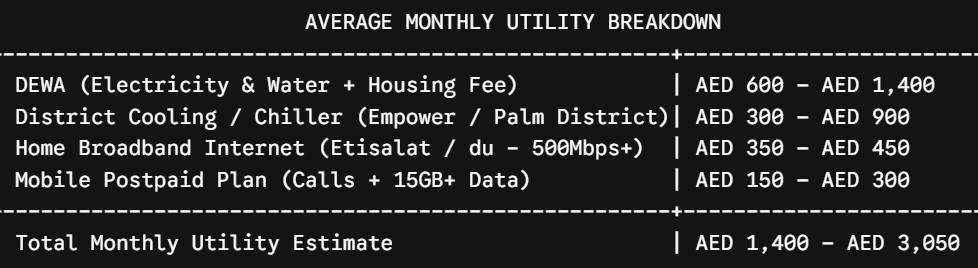
Budgeting for the cost of utilities in Dubai involves three main components: DEWA, cooling, and telecommunications.
Understanding the DEWA Housing Fee
Your DEWA bill totals your gas and electricity consumption for the month plus a municipal Housing Fee of 5% of your yearly rent, split into 12 months. So, a yearly AED 80,000 rent equates to an AED 333 monthly municipal housing fee to be paid to DEWA beyond your use of water and electricity.
Chiller-Free vs. District Cooling Buildings
- Chiller-Free Properties: The landlord covers the building’s central air conditioning costs, meaning your cooling expense is included in your standard DEWA bill.
- District Cooling Buildings: Air conditioning is supplied by specialized providers like Empower or Palm District Cooling. Tenants pay a monthly consumption fee plus a fixed year-round “capacity charge,” regardless of usage.
Grocery & Food Expenses
Groceries and daily dining expenses offer flexibility depending on where you shop and your culinary preferences.
Supermarket Tiers in Dubai
- Budget Supermarkets (Viva, Carrefour, LuLu, Nesto): Ideal for daily staples, locally produced goods, and budget-friendly household items. Monthly spend for a single person averages AED 800 – AED 1,200.
- Premium & Import Outlets (Spinneys, Waitrose, Marks & Spencer): Popular among expats seeking imported European, British, or organic products. Monthly spend for a single person averages AED 1,500 – AED 2,200.
- Family Grocery Budget (Family of Four): Monthly grocery expenses range between AED 3,200 and AED 5,500 depending on your store choices.
Dining Out and Entertainment
- Casual Street Food / Local Eateries: AED 25 – AED 50 per meal.
- Mid-Range Restaurant Dinner (For Two): AED 250 – AED 450.
- Specialty Coffee: AED 18 – AED 26 per cup.
Transportation Costs in Dubai
Navigating Dubai is convenient whether you rely on public transit or maintain a private vehicle.
Public Transit (Dubai Metro, Tram & Buses)
- Nol Card Monthly Pass: Unlimited travel across two zones costs approximately AED 230 – AED 350 per month.
- Taxi Fares: Flag drop starts at AED 12, with an average 15-minute ride costing between AED 30 and AED 55.
Owning a Private Vehicle
- Fuel Prices: Fuel prices in the UAE are adjusted monthly based on international benchmarks, keeping fuel expenses low compared to European or North American averages.
- Leasing a Compact Sedan / SUV: Monthly lease payments range from AED 1,500 to AED 3,200.
- Salik Toll Gates: Dubai uses an automated toll collection system (Salik), charging AED 4 per gate passage. Drivers typically spend AED 150 – AED 350 per month on tolls.
Education, Schooling & Healthcare
For families relocating to the UAE, private education and comprehensive medical coverage represent significant budget factors.
Private School Tuition Fees
Public schools are generally restricted to UAE nationals, meaning expat families utilize private international schools (offering British, American, IB, or Indian curricula).
- Primary School (Grades 1–5): AED 20,000 – AED 55,000 per academic year per child.
- Secondary School (Grades 6–12): AED 35,000 – AED 95,000+ per academic year per child.
- KHDA Rating System: The Knowledge and Human Development Authority (KHDA) regulates private school quality and regulates fee adjustments based on annual school inspection ratings.
Healthcare & Medical Insurance
Health insurance all residents in Dubai are legally required to hold health insurance. It is the legal responsibility of the employer to insure all employees and the sponsorship companies to offer insurance to family members.
- Basic Essential Benefits Plan (EBP): AED 600 – AED 900 per year per person (provides basic local emergency coverage).
- Comprehensive Private Expat Health Insurance: AED 4,500 – AED 14,000+ per year per individual for international coverage, private hospital networks, and dental extensions.
Total Monthly Budget Summary
Putting all categories together provides a realistic estimate of total monthly expenses in Dubai.
Monthly Expenses in Dubai for Single Person
- Value Budget (Shared / Studio in JVC or DSO): AED 6,500 – AED 8,500 per month.
- Mid-Range Budget (1BR in Business Bay / JLT): AED 11,000 – AED 15,000 per month.
- Luxury Budget (1BR/2BR in Downtown / Marina + Private Car): AED 18,000 – AED 28,000+ per month.
Monthly Expenses for a Family of Four
- Mid-Range Budget (2BR/3BR in JVC/Silicon Oasis + 2 School Fees + SUV): AED 24,000 – AED 34,000 per month.
- Premium Expat Budget (3BR/4BR Villa in Dubai Hills + Top IB Schooling + Maid): AED 42,000 – AED 65,000+ per month.
Step-by-Step Relocation & Budget Planning Process
Planning your transition systematically prevents financial surprises upon arrival in Dubai.
Step 1: Calculate Your Net Tax-Free Household Income
Evaluate your offer or business revenue under the UAE’s 0% personal income tax framework to determine your true monthly disposable income.
Step 2: Establish Your Target Housing Budget and Location
Select a community that matches your commuting preferences and budget, accounting for upfront security deposits, agency fees, and DEWA connections.
Step 3: Factor in Upfront Move-In Liquidity
Ensure you hold sufficient liquid cash in bank reserves to cover 3 to 6 months of housing cheques, agency fees, security deposits, and furniture purchases.
Step 4: Finalize School Admissions and Healthcare Coverage
Secure school placements well in advance of your relocation date, and confirm your employer’s medical insurance coverage limits for dependents.
Step 5: Establish Your Corporate Base or Investor Visa
When moving as an entrepreneur and remote business owner, set up your Free Zone or Mainland company structure via emifast to claim your investor visa, Emirates ID, and corporate bank account.
Benefits of Moving Your Business and Residency to Dubai
Establishing a business or residency base in Dubai delivers significant financial advantages:
- 0% Personal Income Tax: Keep 100% of your earnings, dividends, and personal capital gains.
- 0% Capital Gains on Personal Investments: Retain full investment growth across stocks, real estate, and digital assets.
- Strategic Global Access: Position yourself at the center of global trade routes connecting Europe, Asia, Africa, and the Americas.
- World-Class Infrastructure & Safety: Enjoy an exceptionally high quality of life, clean public spaces, and low crime rates.
Frequently Asked Questions (FAQs)
Is Dubai expensive to live in compared to major Western cities?
Cost of living overall, the cost of living in Dubai is comparable to some of the world’s most expensive cities like London, Paris, or New York. Yet, you will get to retain much more of your salary while in Dubai, given that there is a 0% personal income tax on residents of Dubai.
How much are monthly utilities for an apartment in Dubai?
Average one-bedroom apartment utility costs (DEWA electricity and water, municipal housing fee and internet) are between AED 900 AED 1,600 per month, with the higher end for apartments that have district cooling (Empower) charges that are billed separately.
What salary is considered comfortable to live in Dubai?
Financially, you should be earning AED 12,000-18,000 per month as a single person. If you’re a family of four with kids in private international schools, AED 30,000-50,000 is the ideal monthly income for you.