
To be able to run a successful mainland company in Dubai, it’s not enough to get that next DET trade license and open a commercial bank account. All mainland companies across the Emirates are required by law to keep clear, compliant, and audited accounting records.
Financial books and records are tightly overseen following the changes to the UAE Commercial Companies Law, as well as the federal Corporate Tax. The FTA could apply significant administrative penalties for non-compliant books and records and may restrict business license renewal.
This article consists of requirements from accounting standards to statutory accounts, auditing, and good practice for your Dubai mainland company if you own an LLC, Sole Establishment or Branch of a company.
What Are the Accounting Requirements for Mainland Businesses in Dubai?
The Federal Decree-Law No. 32 of 2021 in respect of Commercial Companies, Federal Decree-Law No. 28 of 2022 for Tax Procedures and Federal Decree-Law No. 47 of 2022 on Corporate Tax govern the keeping of accounts in the UAE.
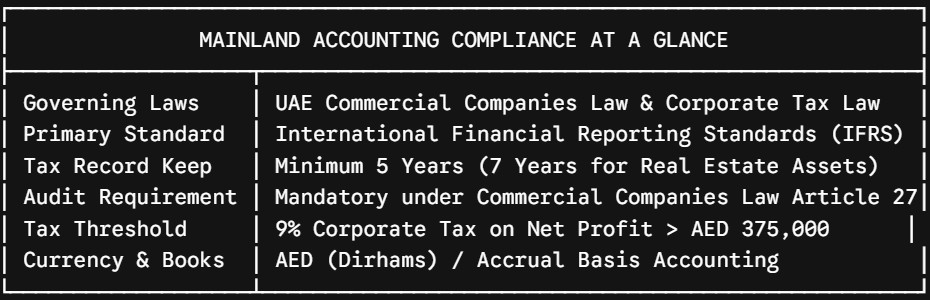
Core Statutory Obligations
- Accrual Accounting Method: Companies must maintain their books of account using the double-entry accrual accounting system rather than cash-basis recording.
- Approved Accounting Standards: Financial statements must be prepared in accordance with International Financial Reporting Standards (IFRS) or IFRS for SMEs.
- Minimum Record Retention Periods: A business must hold on to all records, invoices, bank statements, and general ledger books for a minimum of 5 years following the last day of the tax period (or 7 years for real estate assets).
Why is Accounting Important for Mainland Companies in Dubai?
Proper book-keeping protects your corporate standing, ensures legal compliance, and supports business expansion:
- Legal Compliance with the FTA: Maintaining accurate ledgers ensures your Corporate Tax filings (9% rate on taxable profit over AED 375,000) and Value Added Tax (5% VAT) submissions pass government audits cleanly.
- Smooth Commercial Banking: Local banks in Dubai conduct annual Know Your Customer (KYC) reviews. Banks require updated financial statements to keep corporate accounts active and approve credit lines.
- Investor & M&A Credibility: Clean financial records under IFRS allow partners, venture capital firms, and buyers to evaluate your corporate valuation accurately.
What Accounting Records Should Mainland Businesses Maintain?
Your finance department or outsourced accounting team must systematically record and store several core financial documents:
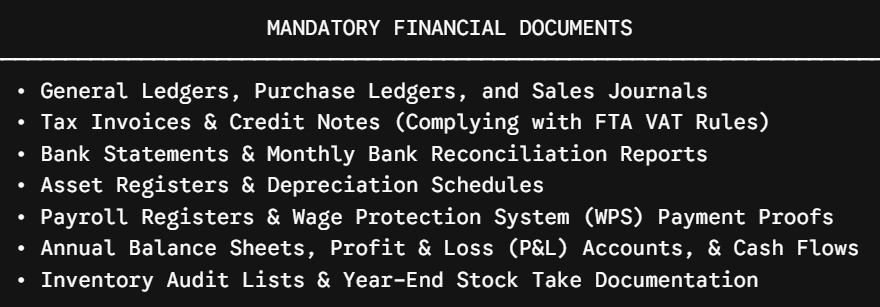
The invoices issued to any of our UAE clients will always show: your 15 digit Tax Registration Number (TRN); line by line cost for each item and the 5% VAT: total in AED.
Accounting Standards and Financial Reporting in the UAE
The official financial reporting framework across the UAE is International Financial Reporting Standards (IFRS).
- IFRS for Large & Listed Entities: Required for enterprise-scale firms, public shareholding companies, and financial institutions.
- IFRS for SMEs: A simplified framework suitable for small-to-medium mainland companies, reducing disclosure complexity while remaining compliant with UAE law.
- Functional Currency: Records are still kept in foreign currencies for the in house processing, but the submission of returns and statutory filings are required in UAE Dirhams AED.
Are Audits Mandatory for Mainland Companies in Dubai?
Yes. Article 27 of the Federal Decree-Law No. 32 of 2021 (UAE Commercial Companies Law) states that every Commercial Company registered in the mainland shall appoint an external auditor, licensed in the United Arab Emirates.
Key Audit Compliance Requirements
- Accredited Auditor: Audits must be performed by an independent auditor licensed by the Ministry of Economy.
- Financial Year-End: Most companies set their initial financial year from the date of incorporation to December 31 of the following year (ranging between 6 and 18 months).
- Filing & Retention: Audited financial reports must be presented to shareholders during the Annual General Meeting (AGM) and retained for government inspection.
Unsure whether your business books are ready for an annual financial audit or FTA tax filing? Connect with Emifast to perform a complete compliance check.
What Are the Risks of Non-Compliant Accounting in Dubai?
Failing to maintain compliant accounting records exposes your business to administrative penalties from the Federal Tax Authority (FTA) and operational disruptions:
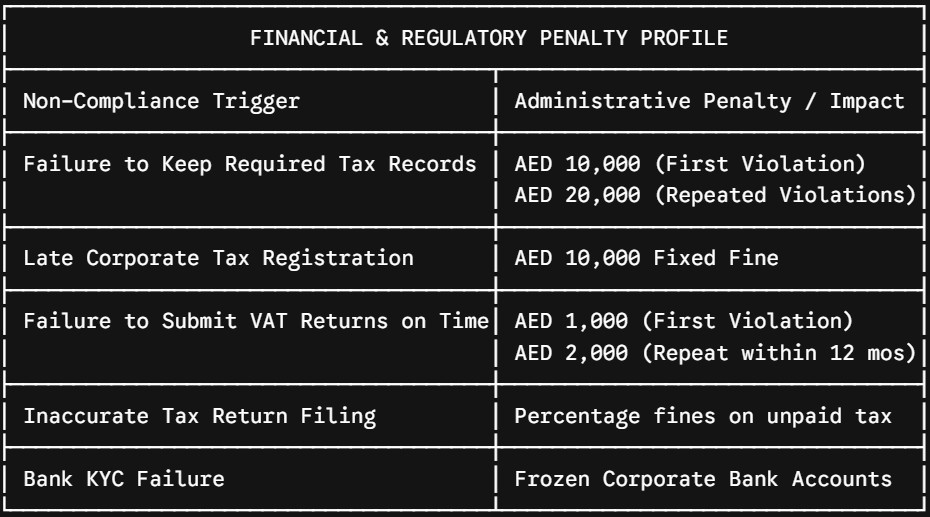
On top of the penalties, non-compliant bookkeeping can result in restrictions to your bank account, license renewal issues with the DET, and the commencement of the FTA formal tax audits by FTA inspectors.
Step-by-Step Accounting Setup Process for Mainland Businesses
Setting up a compliant accounting system for your mainland business involves five clear steps:
1. Select Approved Accounting Software & Setup Chart of Accounts
Implement IFRS-compliant accounting software (such as Zoho Books, Xero, or QuickBooks) configured for UAE 5% VAT rules and the AED currency.
2. Establish Document Management & Invoice Protocols
Create a secure digital storage workflow for all sales invoices, purchase receipts, customs documents, and supplier agreements to satisfy 5-year retention rules.
3. Implement Monthly Bank & WPS Reconciliations
Reconcile bank accounts monthly and verify that employee salary payments clear cleanly through the Wage Protection System (WPS) to maintain labor compliance.
4. Register for Corporate Tax & VAT with the FTA
Complete your Corporate Tax registration to secure your Tax Registration Number (TRN). Register for VAT if your annual taxable turnover exceeds AED 375,000.
5. Engage an Accredited UAE Auditor for Year-End Filing:
Engage an approved UAE audit firm and undergo annual audit, attest your books of account and file your Corporate Tax return before the end of the 9 months period from the end of the financial year.
Cost Breakdown of Accounting & Book-Keeping Services in Dubai
Outsourcing or establishing in-house accounting involves clear operational parameters:
- Basic Outsourced Book-keeping Package (Low Volume): AED 1,200 to AED 2,500 per month. Covers transaction entry, monthly bank reconciliations, and basic financial statements for small businesses.
- Comprehensive Accounting & Tax Filing Package (Mid Volume): AED 3,000 AED 6,500 each month. The service fee covers the daily data entry, management reports every month, quarterly VAT fillings, WPS system payroll management, as well as the release of the Corporate Tax paperwork.
- Full-Time In-House Accountant Salary: AED 6,000 to AED 14,000 per month (plus employment visa, health insurance, workspace overhead, and accounting software licenses).
- Annual External Audit Fees: AED 3,500 to AED 12,000+ per year for small-to-medium mainland entities, depending on annual transaction volume, inventory complexity, and company size.
What are the Benefits of Outsourcing Accounting Services?
For most small and medium-sized mainland companies in Dubai, outsourcing accounting to a specialized advisory partner offers clear operational advantages:
- Cost Savings: Eliminates full-time salaries, employment visa expenses, office workspace overhead, and accounting software subscription fees.
- Access to UAE Tax Experts: Ensures your filings are reviewed by certified tax agents familiar with updated FTA regulations, avoiding penalty risks.
- Continuous System Availability: Removes single-point-of-failure risks caused by employee resignation or annual leave.
How Emifast Can Help With Your Dubai Accounting Requirements
Managing corporate tax rules, VAT filings, and annual audits alongside daily operations can be challenging.
Complete Corporate Advisory from Emifast
The team of corporate setup specialists, accounting professionals, and tax advisors handles your end-to-end financial compliance in Dubai.
Our Services Include:
- Monthly Book-keeping & Financial Reporting: IFRS-compliant record-keeping, management accounts, and cash flow tracking.
- FTA Tax Registration & Filing: Complete Corporate Tax and VAT registration, filing, and compliance management.
- Annual Audit Coordination: Organizing certified audit documentation with accredited UAE auditors.
- Corporate Onboarding & Banking Support: Setup, licensing, and corporate bank account management.
Frequently Asked Questions (FAQs)
Are all mainland businesses in Dubai required to keep accounting records?
Yes. All mainland companies registered in Dubai are legally required to keep accurate accounting books and records using the double entry accrual system of accounting for at least 5 years as per UAE Commercial Companies Law and Tax Procedures Law.
What happens if my mainland business does not perform an annual audit?
Failing to perform an annual financial audit violates Article 27 of the UAE Commercial Companies Law. It can complicate your DET trade license renewal, trigger bank account restrictions during annual KYC checks, and complicate your FTA Corporate Tax submissions.
What accounting software is approved for use in the UAE?
The FTA is not limiting companies for a specific company as we believe that companies should have their choice of a software. But the provided accounting solution should be IFRS compliant, should be able to produce FAF, capable of VAT amount calculation (5%) and should capture the transactions in AED (Zoho Books Xero QuickBooks).
How long must financial records be retained in the UAE?
For at least 5 years after a tax period; financial statements, tax invoices and receipts ledgers bank statements related to this. For at least 7 years, financial statements, tax invoices and receipts ledgers bank statements related to commercial real estate assets.