
The global landscape for digital asset investors, Web3 founders, and professional traders has shifted dramatically. High personal tax burdens, unpredictable regulatory crackdowns, and hostile banking environments across North America and Europe have forced serious market participants to seek a stable, progressive base for their wealth.
Moving to the UAE has become the primary destination for the global crypto community. By combining a 0% personal income tax policy with institutional regulatory frameworks, physical safety, modern infrastructure, and long-term investor residency pathways, the United Arab Emirates provides an unrivaled ecosystem for digital asset growth.
Whether you manage an institutional crypto fund, trade personal capital, or build decentralized protocols, this article covers every financial, legal, and operational aspect of relocating your residency and business to the UAE.
Why Are Crypto Traders Moving to the UAE?
The migration of digital asset wealth to the UAE is driven by structural incentives rather than short-term trends. While other countries treat cryptocurrency with skepticism, the UAE has built a dedicated, legal framework to support virtual asset innovation.
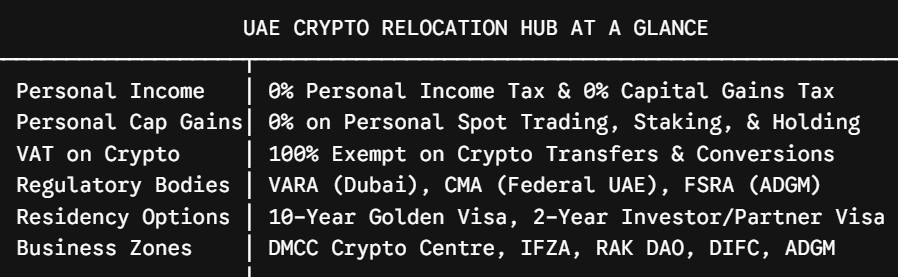
Core Advantages Driving Relocation
- Complete Tax Efficiency: Zero personal capital gains tax on individual digital asset trading, spot appreciation, and personal yield.
- Legal Regulatory Certainty: Comprehensive legal guidelines issued by specialized authorities like Dubai’s Virtual Assets Regulatory Authority (VARA) and the federal Capital Market Authority (CMA).
- High Banking Integration: Established pathways to convert digital assets into local fiat currency (AED or USD) through compliant, VARA-regulated OTC desks and exchange gateways.
- Strategic Global Base: Centrally positioned between European, Asian, and African markets with world-class international travel connectivity.
Zero Capital Gains Tax in the UAE: What You Need to Know
The primary driver for high-net-worth investors moving to UAE is the tax framework governing individual wealth.
Individual Personal Trading vs. Corporate Business Trading
- Personal Investment (0% Tax): If you trade crypto as a natural person managing your personal capital, you pay 0% personal income tax and 0% personal capital gains tax on your returns. This applies to spot trading, holding, staking, and personal portfolio management.
- VAT Exemption: Under Cabinet Decision No. 100, the UAE government exempted all digital asset transfers and conversions from 5% Value Added Tax (VAT), applied retroactively.
- Corporate Tax (9% Threshold): If you structure your trading under a corporate entity (such as a proprietary trading firm or operating company), net taxable corporate profits above AED 375,000 are subject to the standard 9% UAE Corporate Tax rate. Qualifying Free Zone Persons (QFZPs) that satisfy substance and qualifying income rules can access a 0% rate.
Clear Crypto Regulations and Regulatory Clarity
Uncertainty is the greatest risk for financial entities. The UAE provides a legal framework split across specialized regulatory authorities:
1. VARA (Virtual Assets Regulatory Authority)
Established in Dubai under Law No. 4 of 2022, VARA is the world’s first independent regulator dedicated exclusively to virtual assets. VARA issues licenses for Exchange Services, Broker-Dealer Services, Custody Services, Management & Investment Services, and Advisory Services across onshore Dubai.
2. Capital Market Authority (CMA)
At the federal level, the Capital Market Authority (CMA) oversees investment-grade digital assets, tokenized securities, and federal Virtual Asset Service Provider (VASP) activities, maintaining alignment between regional free zones and national security laws.
3. Financial Free Zone Regulators (ADGM & DIFC)
Abu Dhabi Global Market (ADGM) under the FSRA and Dubai International Financial Centre (DIFC) under the DFSA provide international common law jurisdictions tailored for institutional funds, asset managers, and institutional crypto custodian platforms.
Real Residency Pathways for Crypto Traders and Investors
Relocating your physical residency to the UAE requires securing a valid residence visa, which anchors your international tax status:
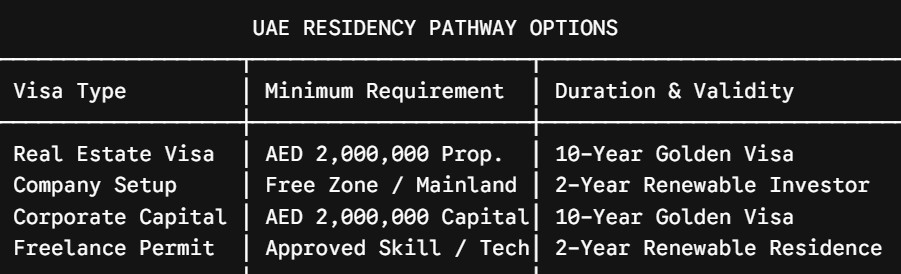
1. The 10-Year Real Estate Golden Visa
By investing at least AED 2,000,000 (~$545,000 USD) in qualifying residential or commercial property (including off-plan properties from approved developers), crypto investors secure a 10-year self-sponsored Golden Visa. This visa allows you to remain outside the UAE for any duration without losing your residency status.
2. Company Formation Investor Visa (2-Year Renewable)
Establishing a corporate entity in a top UAE Free Zone (such as DMCC, IFZA, or RAK DAO) or on the Dubai Mainland qualifies shareholders for a 2-year renewable investor/partner residency visa.
3. Freelance & Remote Work Visas
For independent Web3 developers, smart contract auditors, or consultants, remote work permits provide an entry route to legal UAE residency without establishing a multi-employee company.
Access to Global Brokers, OTC Desks, and Banking Infrastructure
Cashing out digital assets safely without bank account freezes is a primary concern for traders worldwide. The UAE offers a mature ecosystem built for smooth fiat-to-crypto transitions.
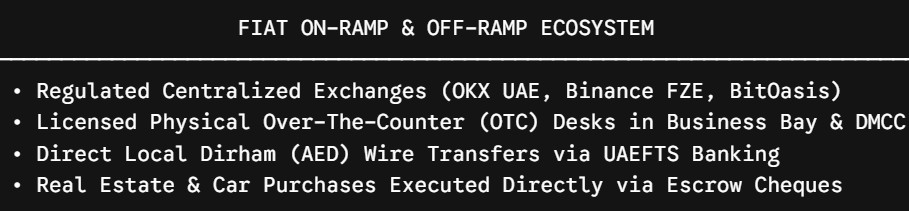
Fiat Off-Ramping Safety Protocols
- VARA-Regulated OTC Desks: Physical OTC desks operating across Dubai allow traders to liquidate large volume positions (USDT, BTC, ETH) directly into Dirham (AED) or US Dollar (USD) bank wires or Manager’s Cheques.
- Same-Name Banking Rules: To ensure seamless bank compliance, local UAE banks require incoming wire transfers from crypto liquidation to bear the exact same legal name as the destination account.
Relocation Process for Crypto Traders
Relocating your personal residency and financial base to the UAE follows a structured sequence:
1. Select Your Relocation & Business Structure
Determine whether you will secure residency via real estate investment, Free Zone company setup (e.g., DMCC Crypto Centre or IFZA), or an individual investor permit.
2. Complete Remote Incorporation & Trade License Issuance
Submit your passport copy, name preferences, and business scope through Emifast to receive your company digital trade license remotely.
3. Travel to the UAE on Entry Permit
Fly into Dubai or Abu Dhabi using your official electronic entry permit to complete your in-person residency procedures.
4. Complete Medical Fitness Screening & Emirates ID Biometrics
Attend an approved preventive health center for your blood test and chest X-ray, followed by biometric capture for your physical Emirates ID.
5. Open Local Personal & Corporate Bank Accounts
Present your Emirates ID, trade license, and business profile to open accounts with digital platforms (like Wio Bank) or established traditional banking partners.
6. Establish Tax Residency & Obtain Tax Residency Certificate (TRC)
Maintain physical presence, establish primary economic ties, and apply for an official UAE Tax Residency Certificate to defend your non-resident status in foreign jurisdictions.
Cost Breakdown of Moving to the UAE for Crypto Investors
Budgeting for your relocation involves evaluating legal setup fees, residency processing, and ongoing maintenance:
- Basic Company Setup (Zero-Visa Package): AED 5,750 to AED 12,500 annually. Ideal for holding intellectual property or non-regulated tech development.
- Full Company Formation Package (1 Investor Visa Included): AED 13,500 to AED 22,000 total Year 1 budget. Covers company license, Establishment Card, entry permit, medical fitness test, Emirates ID, and residency stamping.
- 10-Year Real Estate Golden Visa Processing: AED 4,000 to AED 9,500 in government processing fees (excluding property equity investment).
- Annual Audit & Accounting Services: AED 3,500 to AED 12,000 annually to ensure compliance with Corporate Tax and IFRS rules.
What Does the Future of Crypto in the UAE Look Like?
The UAE continues to expand its digital asset ecosystem through forward-looking national strategies:
- Central Bank Digital Currency (Digital Dirham): Live wholesale and retail execution of the CBUAE Digital Dirham for government and interbank transactions.
- Institutional Real-World Asset (RWA) Tokenization: Frameworks established across DIFC and ADGM for tokenizing commercial real estate, commodities, and private equity funds.
- OECD CARF Implementation: Implementation of the Crypto-Asset Reporting Framework (CARF) starting in 2027 to ensure automatic exchange of tax information globally while keeping local personal tax at 0%.
Frequently Asked Questions (FAQs)
Do crypto traders pay capital gains tax in the UAE?
No. Individual crypto traders managing their personal investments pay 0% personal income tax and 0% personal capital gains tax in the UAE.
Is crypto trading legal in Dubai and the UAE?
Yes. Crypto trading, holding, and business development are legal and regulated across the UAE under bodies like VARA in Dubai, the CMA at the federal level, the FSRA in ADGM, and the DFSA in DIFC.
How can I off-ramp crypto to fiat in Dubai safely?
You can convert crypto to AED or USD by transferring assets to VARA-licensed centralized exchanges (like OKX UAE or Binance FZE) or utilizing licensed physical Over-The-Counter (OTC) desks that issue direct domestic bank wire transfers.
Can I buy real estate in Dubai using cryptocurrency?
Yes. Many developers and licensed brokerages accept crypto payments. Authorized OTC desks act as escrow agents, converting your digital assets into Manager’s Cheques payable directly to the developer or seller.
What visa is best for a crypto trader moving to Dubai?
The 10-year Real Estate Golden Visa (via an AED 2M property investment) or a 2-year Free Zone Company Investor Visa (via corporate formation in zones like DMCC or IFZA) are the most popular options.