
Dubai has long held a global reputation as a premier tax-efficient destination for businesses, investors, and expatriate professionals. The emirate combines modern infrastructure, strategic location, and high living standards with an exceptionally friendly fiscal environment. However, as the United Arab Emirates expands its financial system and aligns with international standards, understanding how tax in Dubai works is vital for anyone living or doing business here.
While the UAE introduced a federal corporate tax structure alongside Value Added Tax (VAT), personal earnings remain completely tax-free.
Whether you are an employee evaluating a job offer, an entrepreneur planning a commercial launch, or a real estate investor building a property portfolio, this guide covers every aspect of taxation in Dubai.
Overview of the Dubai Tax System
Dubai’s fiscal model relies on a balanced combination of zero personal income tax, low indirect consumption taxes, and a competitive federal tax on business profits. This structure generates government revenue while maintaining an attractive market for foreign capital and global talent.
Zero Personal Income Tax Advantage
One of the most attractive features of living in the UAE is the complete absence of personal income taxes. There is no federal or emirate-level tax levied on individual earnings, wages, or personal investment gains. Expatriates and residents retain 100% of their net salary.
Role of the Federal Tax Authority (FTA)
Federal taxes across all seven emirates are administered and enforced by the Federal Tax Authority (FTA). Established in 2016, the FTA oversees taxpayer registration, processes filings through its digital platform (EmaraTax), conducts audits, and enforces compliance across Corporate Tax, VAT, and Excise Tax.
Income Tax in Dubai on Salary & Personal Earnings
A frequent question among professionals migrating to the Middle East is whether there is an income tax in Dubai or any hidden payroll deductions.
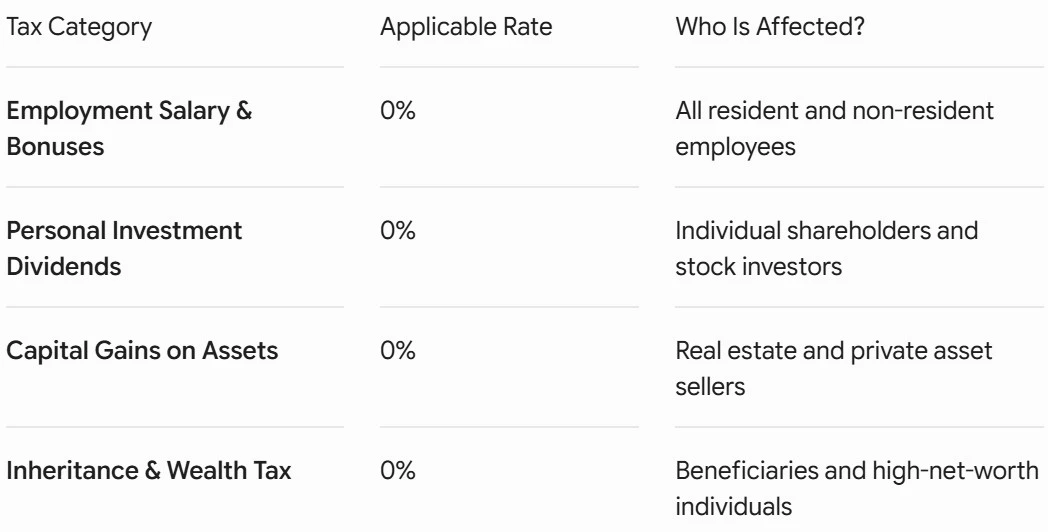
The rule regarding tax in Dubai on salary is straightforward: individuals pay 0% personal income tax on their salaries, bonuses, allowances, and end-of-service gratuities. Employers do not withhold any portion of your income for tax purposes, and individuals are not required to file annual personal tax returns with the government.
Capital Gains, Investment Income & Wealth Exemption
Beyond employment compensation, individuals benefit from zero capital gains tax when selling real estate, stocks, bonds, or personal assets. Dividend income, bank interest earnings, rental returns from personal property, and inherited wealth are also entirely exempt from personal taxation.
Freelancer & Sole Establishment Tax Rules
If you operate as a freelancer or sole establishment, your earnings are treated as personal income as long as your annual business turnover remains below AED 1,000,000 in a calendar year. If your commercial turnover exceeds AED 1,000,000, your sole business activities become subject to corporate tax rules and require formal registration with the FTA.
Corporate Tax in Dubai: Rates, Thresholds & Rules
The implementation of federal corporate tax marks a significant evolution in the UAE’s commercial landscape. Enacted under Federal Decree-Law No. 47 of 2022, corporate tax applies to business net profits across all emirates.
Understanding corporate tax in Dubai is essential for every business entity, including mainland companies, free zone firms, and foreign branch offices.
0% vs. 9% Taxable Income Tiers
The corporate tax system employs a tiered model designed to support small enterprises while ensuring fair contributions from larger corporations:
- 0% Tax Rate: Applies to net taxable profits up to AED 375,000 (approximately $102,000 USD). Startups and small enterprises earning net profits below this threshold pay zero corporate tax.
- 9% Tax Rate: Applies strictly to the portion of net taxable profit that exceeds AED 375,000. For example, if a company generates AED 500,000 in net profit, the first AED 375,000 is taxed at 0%, and the remaining AED 125,000 is taxed at 9% (resulting in a tax liability of AED 11,250—an effective rate of just 2.25%).
Small Business Relief (SBR) Exemption
To further assist startups and growing firms, the UAE Ministry of Finance offers Small Business Relief. Under this provision, resident taxable entities with gross annual revenues of AED 3,000,000 or less in a tax period can elect to be treated as having no taxable income. This means eligible small businesses pay 0% corporate tax and benefit from simplified compliance procedures.
Free Zone Tax Rules (Qualifying Free Zone Persons)
Free zones remain a core pillar of Dubai’s commercial ecosystem. Free zone entities can maintain a 0% corporate tax rate, provided they meet the criteria of a Qualifying Free Zone Person (QFZP). To qualify, the entity must:
- Derive “qualifying income” (such as income from transactions with other free zone entities, international trade, manufacturing, logistics, or headquarters services).
- Maintain adequate economic substance (physical office space and qualified staff) in the free zone.
- Comply with transfer pricing rules and documentation standards.
- Ensure non-qualifying revenue does not exceed the de minimis threshold (5% of total revenue or AED 5,000,000, whichever is lower).
If a free zone entity conducts direct commercial transactions with mainland UAE clients that exceed de minimis limits, that non-qualifying income is taxed at the standard 9% rate.
Multinational Enterprises & Global Minimum Tax (DMTT)
Large multinational enterprise (MNE) groups with consolidated global revenues exceeding EUR 750 million are subject to the Domestic Minimum Top-Up Tax (DMTT). Aligned with the OECD’s Pillar Two framework, this rule applies a 15% tax rate to qualifying MNEs, ensuring international tax compliance without impacting small and mid-sized local businesses.
Consult Emifast’s Corporate Tax Advisory Team to review your tax position and ensure full compliance.
Property Tax in Dubai & Real Estate Fees
Investors entering the Dubai real estate market often ask about property tax in dubai. Unlike many Western jurisdictions that collect high annual property ownership taxes, Dubai does not charge recurring annual real estate holding taxes. Instead, real estate transactions involve specific upfront and municipal fees.
Dubai Land Department (DLD) Transfer Fees
When purchasing residential or commercial property in Dubai, the primary expense is the 4% Dubai Land Department (DLD) transfer fee. This one-time fee is calculated on the total property purchase price and is typically split equally between the buyer (2%) and seller (2%), unless agreed otherwise in the sales contract.
Additionally, buyers pay an administrative registration trustee fee (AED 2,000 plus VAT for properties under AED 500,000, or AED 4,000 plus VAT for properties exceeding AED 500,000).
Housing Fees & Commercial Rental Taxes
While there is no annual property tax on owners, property occupiers pay municipal fees tied to lease agreements:
- Residential Tenants: Pay a 5% municipal housing fee based on the annual lease value. This amount is automatically itemized and collected through monthly Dubai Electricity and Water Authority (DEWA) utility bills.
- Commercial Tenants: Businesses renting offices, retail stores, or warehouses pay a 10% municipal tax on their annual commercial rental contract value.
Indirect Taxes: Value Added Tax (VAT) & Excise Tax
While direct personal income tax does not exist, Dubai utilizes indirect taxation on consumption to support public infrastructure and municipal services.
5% VAT Registration Thresholds & Rules
Value Added Tax was introduced across the UAE in 2018 at a low standard rate of 5%. VAT applies to most commercial transactions, retail goods, restaurant dining, entertainment, and professional services. Certain sectors—such as basic healthcare, public education, residential property sales, and local public transport—are zero-rated or exempt.
Companies operating in Dubai must monitor their turnover against federal registration thresholds:
- Mandatory Registration: Required if your taxable supplies and imports exceed AED 375,000 over the preceding 12 months or are expected to exceed that limit in the next 30 days.
- Voluntary Registration: Permitted if your taxable supplies or taxable expenses exceed AED 187,500 per year, allowing smaller businesses to claim back input VAT on business purchases.
Excise Tax on Select Consumer Goods
Excise tax is a specialized consumption tax levied on specific goods that are considered harmful to human health or the environment:
- 50% Excise Tax: Applied to carbonated drinks, sweetened beverages, and products with added sugar or sweeteners.
- 100% Excise Tax: Applied to energy drinks, tobacco products, electronic smoking devices, and associated liquids.
Benefits of Dubai’s Tax Framework for Investors & Businesses
Dubai’s fiscal model offers significant financial advantages when compared to traditional high-tax international markets.
- Maximised Personal Income: Employees and business owners retain 100% of their earnings without personal tax deductions, providing high disposable income and savings capacity.
- Highly Competitive Corporate Rates: At 9%, the corporate tax rate remains significantly lower than the global corporate average, allowing businesses to reinvest a greater portion of their profits.
- Extensive Double Tax Treaty Network: The UAE has signed over 140 Double Taxation Avoidance Agreements (DTAAs) with countries worldwide, protecting international investors from being taxed twice on the same income.
- Zero Withholding Taxes: Cross-border payments, dividends, interest, royalties, and service fees sent from Dubai entities to foreign shareholders face 0% withholding tax.
- Complete Financial Mobility: Unrestricted movement of capital, allowing investors to move profits, dividends, and corporate reserves globally without currency exchange restrictions.
How to Register for Corporate Tax in Dubai: Step-by-Step
Every business entity holding a commercial license in Dubai—including mainland companies, free zone establishments, and sole proprietors earning above AED 1,000,000—must register for business tax in Dubai with the FTA and obtain a Tax Registration Number (TRN).
Failure to register within designated deadlines can result in administrative penalties, including a flat fine of AED 10,000 for late corporate tax registration.
Step 1: Gather Corporate Documents & Trade License
Collect your active trade license, Memorandum of Association (MOA), lease agreement (Ejari), passport copies, and Emirates IDs of authorized signatories and company managers.
Step 2: Create or Log In to Your EmaraTax Account
Access the official Federal Tax Authority portal (EmaraTax). Log in using your business UAE Pass or register a new user account linked to your corporate email address.
Step 3: Complete Corporate Tax Registration Application
Select “Register for Corporate Tax” from your dashboard. Enter company details, legal entity structure, ownership share percentages, financial year-end dates, and primary business activities.
Step 4: Submit Required Verification Documentation
Upload clear digital copies of your trade license, MOA, lease contract, and authorized signatory identification documents to verify your business application.
Step 5: Receive Your Tax Registration Number (TRN)
Once the FTA reviews and approves your submission, a unique 15-digit Corporate Tax Registration Number (TRN) is issued to your company profile.
Step 6: Maintain IFRS Records & File Annual Tax Returns
Keep accurate accounting records and audited financial statements in accordance with IFRS standards. File your corporate tax return and pay any applicable tax liability within 9 months following the end of your financial year.
Why You Need Corporate Tax Consultants in Dubai
While Dubai’s tax regulations are designed to be clear, navigating financial compliance, free zone exemptions, and transfer pricing requires specialized expertise. Working with qualified corporate tax consultants in Dubai ensures your enterprise stays fully compliant while structuring operations efficiently.
Professional consultants help your business by:
- Evaluating QFZP Eligibility: Determining whether your free zone entity meets all substance and qualifying income requirements to maintain a 0% corporate tax rate.
- Applying Small Business Relief: Electing appropriate tax reliefs to eliminate tax liabilities for businesses with revenues under AED 3,000,000.
- Preventing Financial Penalties: Tracking strict registration and filing deadlines to avoid severe administrative fines from the FTA.
- Structuring Transfer Pricing: Drafting required inter-company pricing documentation to meet international standards for related-party transactions.
- Managing Accounting & VAT Audits: Organizing IFRS-compliant trial balances, financial statements, and periodic VAT filings.
Partner with Emifast for Corporate Setup & Tax Compliance
Whether you are launching a startup, opening a regional branch, or restructuring an existing corporate group in Dubai, navigating regulatory requirements is easier with expert guidance.
Emifast provides end-to-end corporate solutions across Dubai and the broader UAE. From company formation and trade license processing to corporate bank account opening, VAT registration, and ongoing corporate tax compliance, Emifast ensures your business operates smoothly and stays fully aligned with local laws.
FAQs
Is there income tax in Dubai on personal salaries?
No, there is zero personal income tax on salaries, wages, or employment bonuses in Dubai. Employees retain 100% of their compensation without personal tax withholdings or mandatory personal tax return filings.
Do free zone companies pay corporate tax in Dubai?
Free zone companies can maintain a 0% corporate tax rate on their “qualifying income” if they meet Qualifying Free Zone Person (QFZP) criteria, maintain physical substance, and comply with transfer pricing rules. Non-qualifying income or revenue generated from direct mainland commercial trading is taxed at 9%.
Do freelancers need to pay corporate tax in Dubai?
Freelancers and sole proprietors are only subject to corporate tax if their total business turnover exceeds AED 1,000,000 within a calendar year. Earnings below this AED 1,000,000 threshold are treated as non-taxable personal income.