
For international entrepreneurs and companies who are looking for a strategic base in Europe, Malta has been recognized as one of the top jurisdictions. Situated at the meeting point of the Mediterranean, this English, speaking EU member country provides a combination of regulatory stability, excellent market access, and a highly attractive tax system, which is quite rare.
However, navigating a new legal landscape can be daunting. Understanding the specific Malta company formation requirements and its unique tax system is crucial before diving in.
This guide will demystify the process. We will explore the significant benefits, outline the steps for limited company formation in Malta, and show you how to fast-track your entry into the European market.
Why Choose Malta? Key Malta Company Formation Benefits
Malta is not just another island nation; it is a highly reputable financial centre that has attracted major players in iGaming, finance, shipping, and digital industries.
The Tax Advantage (The 6/7ths Refund)
This is the primary draw for many international investors. Malta operates a full imputation tax system. Initially, the rate for the corporate tax was 35%. Yet, when the dividends are paid to the shareholders, those shareholders are generally qualified to a refund of 6/7ths of the tax the company has already paid on its trading profits.
Such a provision can potentially bring down the net tax drain to a mere 5% in most cases, thus qualifying Ireland as one of the most tax efficient onshore jurisdictions in Europe.
Strategic EU Access and Stability
Being a full member of the European Union since 2004 and a part of the Eurozone, a Maltese company gets full “passporting” rights. This means that you can provide services to any of the 27 EU member states without having to go through a complicated re-licensing process. Malta also has a politically stable climate and a strong legal system based on civil law but significantly influenced by the principles of English common law.
Pro-Business Environment
English is an official language in Malta, meaning all legislation, court proceedings, and business documentation are available in English, significantly reducing administrative friction for international business owners.
Understanding Company Structures: Limited Company Formation Malta
When considering Malta company formation, you must choose the right legal structure. The most common vehicle for international business is the limited liability company.
Private Limited Company (Ltd.)
This is the most common structure chosen by small to medium businesses. It allows that there be at least one shareholder (which can be either individual or corporate) and one director. It limits the shareholder’s right to transfer their shares and forbids the issuing of invitations to the public to subscribe for shares or debentures.
Public Limited Company (Plc)
This structure is suited for larger enterprises that may wish to raise capital from the public. It has higher minimum share capital requirements and stricter governance rules compared to a private company.
Essential Malta Company Formation Requirements
Before initiating the process, you must ensure you can meet the core legal requirements set by the Malta Business Registry (MBR).
- Shareholders and Directors: You need a minimum of one shareholder and one director. They can be of any nationality and do not need to be resident in Malta (though local residency helps with tax substance).
- Company Secretary: Every company must appoint a Company Secretary. This must be an individual (not another company) responsible for maintaining statutory registers and ensuring regulatory filings are met.
- Registered Office: You must have a physical registered office address in Malta where official mail can be served. A simple PO Box is not accepted.
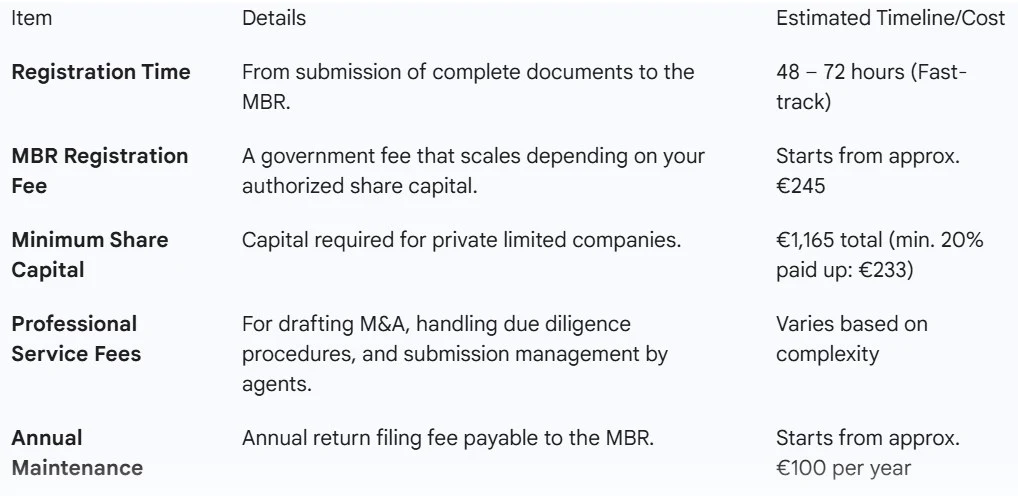
- Minimum Share Capital: For a private company, the minimum authorized share capital is €1,165, of which at least 20% (€233) must be paid up upon incorporation.
Struggling with compliance documents? Let Emifast handle the due diligence and drafting of your Memorandum & Articles to ensure a smooth approval.
Step-by-Step: The Malta Company Formation Process
Thanks to an efficient business registry, the actual Malta company formation process is swift once your documentation is in order.
- Choose Your Company Name: Select a unique name and reserve it with the Malta Business Registry (MBR) to ensure it is available.
- Prepare Due Diligence Documents: This is the most time-consuming phase. You must gather certified passports, proof of address (like utility bills), and often bank references for all ultimate beneficial owners (UBOs), directors, and shareholders.
- Draft the Memorandum and Articles of Association (M&A): This is the company’s constitution, outlining its objectives and rules. It must be drafted compliantly with Maltese law.
- Deposit Minimum Share Capital: You must open a “company in formation” bank account with a local or approved foreign bank to deposit the paid-up share capital. You will receive a deposit slip as proof.
- Submit Documentation to the MBR: The M&A, due diligence documents, bank deposit slip, and registration fees are submitted to the Registrar of Companies.
- Receive Certificate of Registration: Once the MBR approves the application, they issue the Certificate of Registration. Your company now legally exists.
- Tax and VAT Registration: The final step before trading is registering the new entity with the Commissioner for Revenue to obtain tax and VAT numbers.
Estimated Costs and Timelines Checklist
Understanding the investment required is vital. Below are estimated guidelines for a standard private company setup.
Post-Formation: Banking and Compliance
Forming the company is step one. Operating it requires ongoing compliance.
Opening a corporate bank account for a company with foreign shareholders has become more stringent across Europe. Malta is no exception. Banks perform deep due diligence on the business model and owners.
Furthermore, to benefit from Malta’s attractive tax regime, it is crucial to demonstrate “economic substance” in Malta. This means key management decisions should be made in Malta, and the company should have an appropriate level of physical presence and expenditure in the country.
Why You Need Professional Malta Company Formation Services

While the MBR registry is efficient, the surrounding requirements – drafting a compliant M&A, navigating stringent bank account opening procedures, and ensuring you qualify for tax refunds – are complex.
Using professional Malta company formation services ensure:
- Your due diligence pack is correct the first time, preventing rejection.
- You have the mandatory registered office address and a reliable Company Secretary.
- You receive introductions to banks that understand international business.
- You remain compliant with annual filings to avoid penalties.
Conclusion: Start Your Malta Journey
Establishing a company in Malta is a strategic move that offers a gateway to Europe and a highly competitive fiscal environment. It is a jurisdiction designed for businesses looking for legitimacy, stability, and growth.
Don’t let bureaucratic complexity hold you back from your European expansion.
Frequently Asked Questions (FAQs)
Can a non-resident form a company in Malta?
Yes, certainly. When it comes to Malta company formation, there is no limitation on the nationality or residency of shareholders or directors. In fact, the whole procedure can usually be done from a distance through the use of powers of attorney.
Is a physical office required in Malta?
Yes, every Maltese company must have a registered office address physically located in Malta where official documents can be served. A PO Box is not sufficient.
What is the minimum share capital for a private limited company?
The minimum authorized share capital for a private company is €1,165. At least 20% of this amount (approximately €233) must be deposited into a bank account prior to incorporation.
Do I need a local director or secretary in Malta?
You do not need a local resident director. However, you must appoint a Company Secretary (an individual, not a corporation) who is responsible for statutory filings. While they don’t have to be resident, having local officers helps demonstrate tax substance.
How long does the entire Malta company formation process take?
Once all due diligence documents (KYC) are collected and the share capital is deposited, the actual registration with the Malta Business Registry (MBR) usually takes between 48 and 72 hours.